
A trading bot is software that follows predefined rules. It does not think like a person or know what the market will do next. It checks data, applies the rules you selected and produces an action such as buy, sell, close or hold.
How a trading bot processes a decision
Price, volume and candles arrive
EMA, VWAP, RSI or other values are calculated
Entry and exit conditions are checked
Position size, stop and target are applied
Buy, sell, close or hold is recorded
See the concept inside GetMyTradingBot
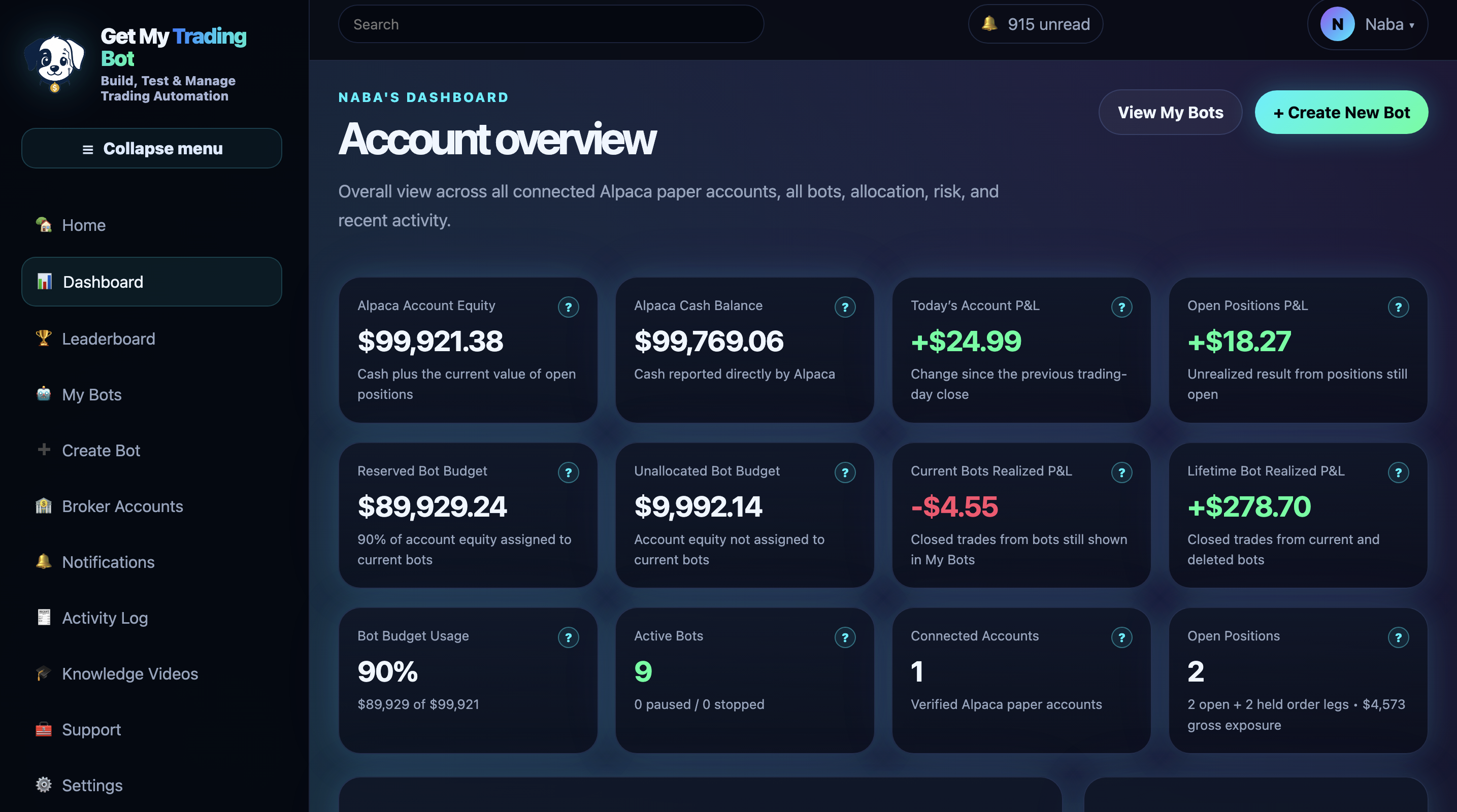
The basic workflow
Most trading bots follow the same loop: receive market data, calculate indicators, evaluate entry and exit conditions, apply risk rules and record the result.
- Market data provides price, volume and candle information.
- Indicators summarize recent market behavior.
- Strategy rules decide whether conditions are met.
- Risk settings control position size, stop loss and take profit.
- Order handling sends a paper or live order to a connected broker.
What a bot can and cannot do
A bot can apply the same instructions repeatedly without becoming tired or emotional. It can also monitor several symbols faster than a person.
A bot cannot guarantee profit, predict unexpected news or remove market risk. Poor rules can be automated just as easily as good rules.
Why beginners should start with paper trading
Paper trading lets you observe how the strategy behaves using simulated funds. It is useful for finding logic errors, unrealistic assumptions and risk settings that are too aggressive before real money is involved.
Frequently asked questions
Do trading bots guarantee profit?
No. A bot only automates rules. Results depend on market conditions, data, execution, costs and the quality of the strategy.
Do I need coding experience?
Not when using a no-code builder. You still need to understand the rules and risks you select.
Can a bot trade while I am away?
Yes, when the runner, broker connection and schedule are active. Monitoring and safeguards are still important.